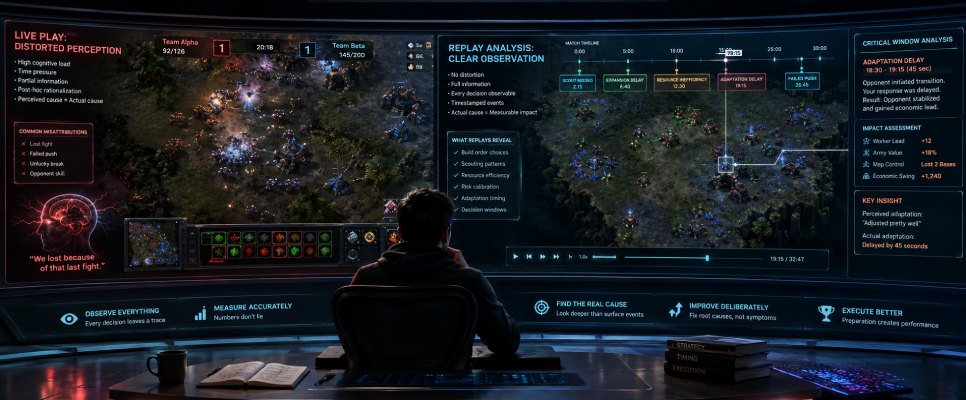
Why Replay Analysis Reveals Strategic Failure More Reliably Than Live Play
Cognitive load during a live match is substantial enough to distort perception of what actually happened. Players operating under time pressure rely on instinct, partial information, and post-hoc rationalization, which means their immediate read of why they lost is often wrong. A player might attribute a defeat to a failed late-game push when the actual failure occurred twenty minutes earlier in scouting sequencing or expansion timing.
Replays remove that distortion entirely. Every decision becomes observable and timestamped, from build order choices in the opening minutes to risk calibration during contested mid-game transitions. Analysts can isolate specific windows where an opponent's vulnerability went unexploited, or where resource inefficiency compounded across multiple build cycles into a structural disadvantage.
There's no denying that experienced players often overestimate their own adaptability under uncertainty. Replays expose the gap between perceived flexibility and actual response patterns. A player who believes they adjusted well to an unexpected rush may, on review, have delayed their adaptation by a critical 45 seconds, enough time for the opponent to stabilize and consolidate an economic lead.
Separating perceived cause from actual cause is where replay analysis earns its value in competitive preparation.
Key Performance Dimensions To Evaluate in Competitive Strategy Game Replays
Structured replay review requires a benchmarking framework, not casual observation. Four dimensions consistently separate meaningful analysis from outcome-fixated review.
Economic efficiency is the first and most revealing layer. Idle production cycles, unspent resources past the mid-game threshold, and mismatched unit production relative to strategic intent all surface clearly in replay timelines. A player who banks 800 minerals while delaying a critical tech transition has not made one mistake – they've compounded several.
Scouting behavior and information interpretation form the second dimension. Replay review should map scouting pathing against actual decision changes: did observed opponent expansions alter build order timing? Missed scouting windows that preceded late-game positional losses are among the most underdiagnosed failure points in competitive play.
Decision timing and transition management reveal whether a player's strategic intent survived contact with the match. Delayed tech switches, hesitant army commitments at identified power spikes, and failure to convert economic leads into map control all register as execution gaps rather than strategic failures.
Response quality under pressure exposes overcommitment patterns, positional errors during retreats, and mismatches between read and reaction. Comparing these four dimensions across both wins and losses produces performance insight that outcome-based review simply cannot replicate – a player can win while executing poorly, and that pattern, left unexamined, compounds over time.
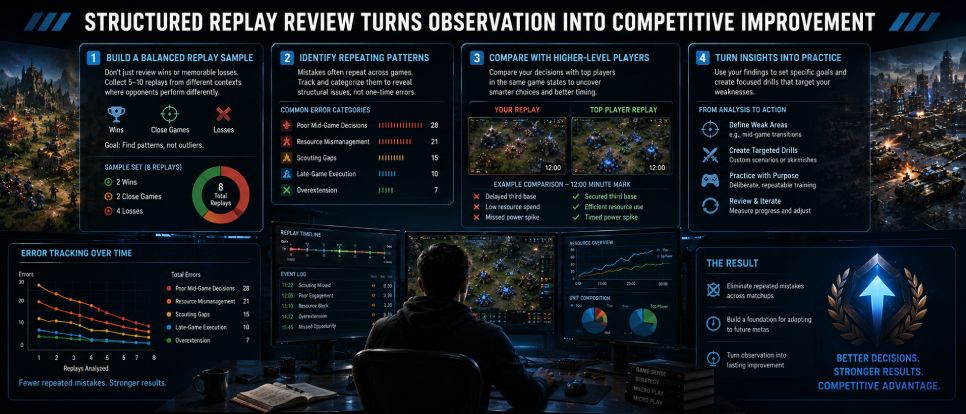
Structured Replay Review Turns Observation Into Competitive Improvement
If one is serious about using a video analysis, just isolating and observing games taken at random is insufficient. A video analyst should obtain as many as five to ten clips that could emerge from different contexts where opponents perform differently and uses those games for joint observation, rather than selecting only wins or most atrociously memorable losses. At the end of the day, what we are trying to create is a pattern reflection, rather than a dataset of extreme outliers.
Often, finding a mistake amongst the functions repeats itself over a series of games. Match or series of series with plenty of nitpicked exaggerations from a player wanting to finish off at an unfavorable mid-game for 90% of the time must be lazily structured and intensely encoding as a perpetual existential dagahoff rather than an innocent oversight. If the video analyst had a scheme that counts errors in relevance to elaborative stands and breeding of straight-up categorizations for use in declutching means of correcting and relationship with episodic mistakes, the player would subtly dot the design of his report generation through the course of training.
Furthering the analysis means comparing one's decision-making against replays that reflect those states of the game for higher-ranked players. It is from these direct observations that valuable, concrete insights are derived by way of comparison—watching how the top player makes critical decisions pertaining to resource allocation at the twelfth minute, contrasting and relating the decision-making process to one's own in the same scenario.
These evaluations would then have to translate into specific practice objectives. Any other plausible practice component must hinge on the recognition of certain weak aspects in the player's game. Custom skirmishes, or drills based on specific scenarios, need to be set up to work on things like this-not some general play. Finally, the strategy eliminates repeated errors in multiple matchups and puts in place the basis for adapting to future competitive metas.
I think it's kind of depressing that the very top selling Real Time Strategy games of all time are still Age of Empires 2 (1999) and StarCraft (1998).
— Sandy Petersen 🪔 (@SandyofCthulhu) December 1, 2025
Has there been no huge improvements in real time strategy in 26 years? pic.twitter.com/lllV9zcBSU