
What Mid-Tier Events Must Optimize
Organizers at this level rarely get to optimize for just one thing. Ranking accuracy, upset resistance, round economy, and participant experience all compete for priority simultaneously, and the tension between them determines which format actually fits a given event.
Broadcast windows and venue contracts impose hard limits. A regional qualifier with two days and four courts cannot run a full round-robin for 32 teams regardless of its statistical advantages. Seeding sensitivity matters too: formats that collapse when early seeds are misassigned punish organizers for imperfect pre-event information.
The measurable criteria that allow meaningful comparison across formats are roughly these: probability that the strongest entrant reaches the final (ranking accuracy), minimum guaranteed matches per participant, number of rounds required to produce a result, rematch rate, and operational complexity per additional team.
For mid-tier specifically, guaranteed matches carry unusual weight. Teams outside the top bracket still need enough games to justify travel and entry costs - there's no denying that participant retention across seasons depends on it.
Comparing the Main Mid-Tier Tournament Formats
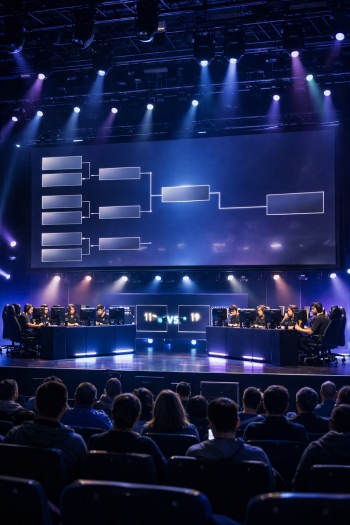
Each format carries a different tolerance for error, and at the mid-tier level, that tolerance matters more than most organizers admit.
Single-elimination is the most logistically convenient option. One loss ends a competitor's run, which keeps round counts low but produces noisy results. Under uneven skill distributions, a strong seed drawn against another strong seed in round one is simply eliminated. Seeding quality is the main safeguard here; without it, bracket luck dominates.
Double-elimination recovers some accuracy by giving each competitor a second path. The loser's bracket catches legitimate contenders who stumble early, though the format roughly doubles the round budget.
Round-robin groups produce the most reliable latent ranking within a pool, but scaling beyond eight to ten participants becomes impractical fast.
Swiss-system formats thread a useful middle path. Participants are paired against opponents with matching records each round, eliminating dead matches while keeping most players active through later stages. A five-round Swiss across 32 players is genuinely workable.
Hybrid models, typically round-robin pools feeding a single-elimination bracket, trade some ranking precision for manageable logistics, which is often the right call.
Designing Progression Systems That Preserve Competitive Meaning
Qualification slots and bracket conversion rules do more structural work than most organizers realize. When a group stage sends three of four teams into playoffs regardless of record, late group matches lose consequence. Teams that clinch early have no incentive to perform, and dead rubbers follow almost mechanically. Limiting advancement to two per group, with the third-place finisher entering a lower bracket rather than eliminating cleanly, tends to keep all matches meaningful through the final round.
Tiebreaker overreliance is a separate problem. Buchholz-style systems reward scheduling luck as much as performance, particularly in Swiss formats where opponent strength varies unpredictably across the field.
Points-based season pathways handle this better for developmental circuits. A rolling points table across four monthly events, with the top eight qualifying for a finals bracket, rewards consistency rather than single-event variance. Organizers prioritizing talent filtering should combine double-elimination brackets with strict head-to-head tiebreakers. Those focused on audience clarity benefit most from clean single-elimination playoff rounds seeded directly from group standings.
The Best Structure Depends on What Progression Must Reward
No one type of middle-tier bracket is the best one in all cases. Organizers who treat the format issue and advancement rules as unconnected and separate decisions strew the initiative. Sure, seeding through the bracket determining the winner with reasonable advancement rules is the complete equation; bad seeds can be rectified sometimes by good rules of advancement (e.g., limiting to top 2 seeds advancing from each pool). Swiss-algorithms are the best way to appreciate seeding situations, followed by single-elimination. Still, in what may be a narrower margin, the group format plays best once the ends are tied quickly in the tiebreaker system. Of all-Swiss, no elimination matches or pairings until finalized into knockout, hybrid types distinguish themselves by balancing legitimacy and realistic methods of operating. Rather than size being critical, context forces every compromise. The format and its progression rules must be compared with each other, no matter what.
I think it's kind of depressing that the very top selling Real Time Strategy games of all time are still Age of Empires 2 (1999) and StarCraft (1998).
— Sandy Petersen 🪔 (@SandyofCthulhu) December 1, 2025
Has there been no huge improvements in real time strategy in 26 years? pic.twitter.com/lllV9zcBSU